
Market Overview
The U.S. economy remained resilient during the third quarter, supported by solid consumer demand, strong productivity, and robust capital investment, particularly in artificial intelligence infrastructure. Labor-market momentum slowed as the quarter progressed—nonfarm payrolls increased by 29,000 in September while unemployment held near 4.2%—but conditions remained broadly stable. Inflation continued to run above the Federal Reserve’s 2% objective, even as August measures showed some moderation. In response to persistent price pressures and higher energy costs, the Federal Reserve raised its target rate by 0.25 percentage point in September to 3.75%–4.00%, while its updated projections pointed to stronger 2026 growth and the possibility of additional tightening.
Financial markets delivered mixed results. The S&P 500 advanced roughly 2.3% and the Nasdaq gained roughly 2.5%, driven largely by large-cap technology and AI-related companies, while the Dow declined 2.7% and small-cap stocks fell more sharply. International equity markets were also mixed, as developed markets declined modestly while emerging markets advanced, supported by continued strength in technology-oriented Asian markets. Energy shares benefited as crude oil rose nearly 30%, but the increase also revived inflation concerns and contributed to a broad rise in interest rates. The 10-year Treasury yield climbed approximately 0.88 percentage point during the quarter to about 5.3%, pressuring bond prices and rate-sensitive sectors. The quarter therefore ended with positive headline returns for major growth indexes, but narrower market leadership and greater stress across fixed income and the broader equity market.
Rates on the Rise as Oil Remains Volatile
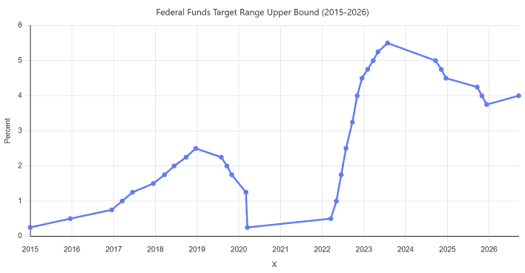
During the third quarter, financial markets navigated the intersection of tighter monetary policy and renewed volatility in energy markets. While the Federal Reserve maintained the federal funds target range at 3.50%-3.75% throughout most of the quarter before raising it modestly to 3.75%-4.00% in September, investors continued to assess the cumulative impact of nearly two years of restrictive monetary policy on economic growth, corporate earnings, and inflation. Year-to-date, the easing cycle that began in late 2024 has helped stabilize interest-rate-sensitive sectors, supporting credit conditions and reducing pressure on borrowers, while longer-term Treasury yields have remained influenced by inflation expectations and fiscal concerns
Changes in the Federal Funds Target Range
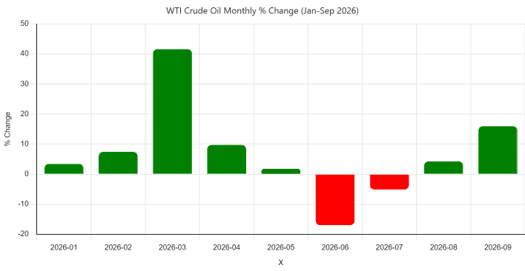
Energy markets were considerably less stable. After beginning the year near $60 per barrel, WTI crude oil prices surged above $100 per barrel during the spring amid significant geopolitical disruptions affecting global energy supplies. Although prices retreated during June and July, crude oil rebounded sharply during the third quarter, finishing September near $97 per barrel. These large swings contributed to uncertainty surrounding the inflation outlook, as changes in fuel and transportation costs filtered through supply chains and consumer spending patterns. The resulting volatility complicated efforts by policymakers and market participants to determine whether inflation pressures were continuing to moderate on a sustainable basis.
Crude Oil Prices – WTI
From an economic and market perspective, the first nine months of 2026 highlighted the competing forces of easing monetary conditions and elevated commodity-price risk. Lower policy rates relative to 2024 generally supported equity valuations, business investment, and housing activity, while the rebound in oil prices created a potential headwind by increasing input costs and inflation expectations. Looking ahead, the likelihood of a sustained series of additional Federal Reserve rate increases appears limited. Although the Fed raised the target range modestly in September, policymakers continue to balance the risk of renewed inflation against signs that prior tightening has already slowed portions of the economy. As a result, financial markets have generally interpreted recent policy actions as a recalibration rather than the beginning of a new tightening cycle. Entering the fourth quarter, investors remain focused on incoming inflation and labor market data, with future rate decisions likely to depend heavily on whether energy-driven price pressures persist or prove temporary
Strong Earnings Growth
Corporate earnings remained a significant tailwind for equity markets during the third quarter and year-to-date. Consensus expectations call for S&P 500 earnings growth of roughly 29% to 31% year over year in the third quarter, marking the third consecutive quarter of growth above 25% and extending the current streak of double-digit earnings gains. Strength has been led by Information Technology, Communication Services, and Energy companies, with continued investment in artificial intelligence infrastructure driving robust revenue and profit expansion among many large-cap technology firms. Importantly, earnings growth has broadened beyond a handful of companies, with most sectors expected to post positive year-over-year profit gains and analysts generally revising estimates higher during the quarter rather than lower, an unusual development that reflects improving corporate fundamentals.
Looking ahead, the earnings backdrop remains constructive, although growth rates are expected to moderate from the exceptionally strong pace seen earlier in the year. Fourth-quarter earnings forecasts continue to benefit from resilient consumer spending, healthy corporate balance sheets, and ongoing AI-related capital expenditures, while management guidance has remained broadly favorable. For 2027, Wall Street expectations point toward another year of earnings expansion, supported by productivity gains from technology investments, continued digitalization across industries, and a still-growing U.S. economy. Key risks include higher-for-longer interest rates, geopolitical uncertainty, and the possibility that corporate profit margins face pressure from labor and financing costs; however, current forecasts suggest that earnings growth should remain positive and above long-term trend levels, providing fundamental support for equity valuations.
AI Influence on the Economy and Financial Markets
Artificial intelligence has remained one of the most important forces shaping both economic growth and financial market performance. During the third quarter, businesses continued to accelerate spending on data centers, cloud infrastructure, advanced semiconductors, and supporting technology platforms, helping drive a surge in corporate capital expenditures. This investment cycle has extended well beyond the technology sector, benefiting industrial companies, utilities, communications providers, and real estate firms tied to digital infrastructure development. The resulting increase in business investment has supported economic activity, strengthened productivity expectations, and contributed to the robust earnings growth reported by many large-cap companies during the quarter.
Looking ahead, AI-related investment is expected to remain a powerful economic catalyst through the fourth quarter and into 2027. Technology companies are committing unprecedented amounts of capital to expand computing capacity, with industry-wide spending on data center construction and AI computing equipment reaching hundreds of billions of dollars annually. Financial markets have reflected these expectations by assigning premium valuations to companies positioned to benefit from the AI buildout, particularly within the technology, semiconductor, and infrastructure sectors. While investors will continue to monitor whether future cash flows justify these large capital commitments, current projections suggest that ongoing AI adoption, continued infrastructure investment, and anticipated productivity gains should remain important drivers of corporate earnings growth, economic expansion, and market leadership through 2027.
Market Rotation
Beneath the headline rally in tech, gains during the quarter were quite broad. The S&P 500 has gained 10.2% through the first half of the year but strip out the tech sector and that falls to 5.1%, an indication of how much of the index’s return comes from that one sector. Other market segments, such as small-cap (+21.5%), mid-cap (+13.8%), and international emerging market equities (+24.1%) continue to perform well during the quarter. For most of the past few years, the stock market’s gains were concentrated in a handful of mega-cap tech stocks. The market has become more balanced as this broadening has occurred.
Several developments explain why the rest of the market has been playing catch-up, the first being profitability. Smaller companies’ profit margins weakened in 2022 and 2023 as inflation spiked and the Federal Reserve raised interest rates. Small-caps tend to carry more floating-rate debt, so as the Fed cut rates in recent years, the interest savings flowed to their bottom line. The second is the economy. Smaller companies are more sensitive to domestic economic conditions, so the economy’s resilience has been a direct tailwind. There were concerns that this year’s oil shock would weigh on the global economy like past oil crises. However, today’s economy depends far less on energy than it did in the 1970s, and the impact has so far been relatively contained. The third is valuation. After years of tech stocks leading the market, smaller companies look cheaper by comparison, and their improving earnings have made that gap harder to overlook.
No single factor explains the shift, but together they make a fundamental case for why the gap has started to close. Profit margins are improving, the economy continues to expand, and parts of the market trade at valuation discounts. As this year has shown, holding a mix of company sizes, styles, and geographies means not depending on any single part of the market doing well.
Equity Market Recap
U.S. large-cap equities generated positive returns during the third quarter, with the S&P 500 advancing approximately 2.3%, supported by continued strength in corporate earnings, resilient economic growth, and ongoing enthusiasm surrounding artificial intelligence investment. While overall index gains were more modest than those seen earlier in the year, the quarter highlighted the growing influence of AI-related spending on market leadership. Investors continued to favor companies benefiting from substantial capital expenditures on data centers, cloud infrastructure, and semiconductor production, while robust corporate earnings growth and generally favorable earnings guidance provided additional support for equity valuations.
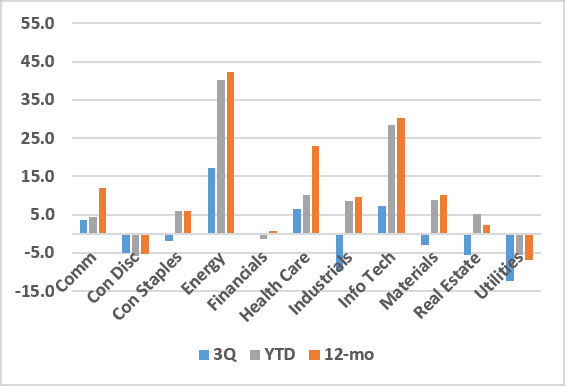
Sector performance was uneven during the quarter. Energy emerged as the strongest-performing sector, gaining roughly 17%, aided by higher oil prices and concerns surrounding global energy supply. Technology was another leader, advancing more than 7% as investors remained focused on AI-driven revenue growth and infrastructure spending. Healthcare also posted solid gains. In contrast, Utilities were the weakest-performing sector, declining more than 12%, while interest-rate-sensitive areas of the market struggled amid rising Treasury yields and expectations for a more restrictive monetary policy environment. Year-to-date, Technology and Energy have been the primary contributors to large-cap market performance, underscoring the importance of both the AI investment cycle and commodity strength as key drivers of equity returns.
S&P 500 Sector Performance
U.S. small- and mid-cap equities declined during the third quarter, underperforming large-cap stocks as investors continued to favor the largest technology and AI-related companies. Growth-oriented small- and mid-cap stocks generally proved more resilient than value stocks, supported by stronger earnings expectations and greater exposure to innovation-driven industries, while many value-oriented sectors faced pressure from higher borrowing costs and a more challenging economic environment. The quarter’s performance reflected investor caution toward companies that are more sensitive to financing costs and economic growth trends.
Looking ahead, the outlook for small- and mid-cap stocks remains closely tied to the path of interest rates. While resilient economic growth and improving earnings could support a recovery in performance, the possibility of additional interest rate increases in the coming months presents a potential headwind. Smaller companies typically rely more heavily on external financing than their large-cap counterparts, making them particularly sensitive to rising borrowing costs. As a result, growth stocks may continue to benefit from stronger earnings momentum, while value stocks could face pressure if higher rates weigh on economically sensitive sectors. Nevertheless, valuations for both small- and mid-cap equities remain attractive relative to large-cap stocks, which could provide support should earnings growth broaden and investor sentiment improve.
International developed equity markets generated positive returns during the third quarter and remained solidly higher on a year-to-date basis, supported by resilient economic growth, improving earnings expectations, and continued investment in technology and artificial intelligence. Performance, however, varied considerably across regions. Japanese equities were among the strongest performers, benefiting from improving corporate governance, robust earnings growth, and a weaker yen, while several northern European markets also posted solid gains. In contrast, continental European markets lagged, particularly France, where concerns surrounding fiscal sustainability, rising government borrowing costs, and political uncertainty weighed on investor sentiment. From a sector perspective, Information Technology, Industrials, and Communication Services generally led returns as investors favored companies exposed to digital infrastructure, automation, and AI-related capital spending. Conversely, Energy and Consumer Staples were among the weaker areas as commodity prices remained volatile and investors rotated toward more cyclical growth-oriented sectors. Year-to-date, leadership has similarly been concentrated in technology-oriented industries and export-driven markets, while more defensive sectors and markets facing fiscal or political headwinds have generally underperformed.
International
Shifting to international equities, the MSCI EAFE Index rose 10.8% for the quarter and is up 9.4% through the first half of the year. The dominant driver was continued momentum in artificial intelligence and related capital investment cycles, which strengthened technology-heavy markets and economies that are embedded in semiconductor and advanced electronics supply chains. Investors increasingly favored growth-oriented companies with long-term earnings drivers over cyclical exposure. At the same time, moderating inflation pressures and relatively stable interest rate expectations supported investors’ risk appetite.
Eurozone equities were strong performers over the quarter. Information technology and financials led the way based on strong corporate earnings. Energy and communication services posted negative returns for the quarter. Energy stocks suffered as oil prices dropped down to levels seen before the outbreak of hostilities in the Middle East. UK stocks gained during the quarter, although declines for the heavyweight energy sector capped overall progress. The top performing sectors included consumer discretionary, real estate, and financials. The Euro area’s annual inflation rate ticked up slightly mid-quarter which led to a 25-bps increase in rates by the European Central Bank. Data provided by Eurostat also showed that eurozone GDP fell by 0.2% during the first quarter.
Japanese equities delivered robust gains in the 2nd quarter with the tech-heavy Nikkei 225 index up over 37%. Investor sentiment was lifted by receding Middle East tensions following the US-Iran ceasefire memorandum which saw oil prices decline. Stocks also drew support from broadly in-line monetary policy outcomes from both the Fed and the Bank of Japan. The latter raised its policy rate by 25 bps to 1.0% in June. The yen continued to be weak over the quarter, reaching a neat 40-year low versus the dollar, which ultimately provided support for exporters. AI and semiconductor related stocks and financials outperformed, though valuation concerns and profit-taking in AI names introduced intra-month volatility in June.
Emerging markets rose sharply in the 2nd quarter with a gain of 24.1%, its strongest absolute quarterly performance since 2009. For the year-to-date period, the index is up 23.9%. Like other markets around the globe, returns were dominated by technology-oriented markets such as Taiwan and Korea. Also, like other markets, the emerging markets judged the Middle East conflict to be largely contained, with the fragile peace agreement helping to ease some geopolitical concern.
Korea was the standout performer as it rallied sharply to all-time highs boosted by outsized returns in memory and AI-related stocks. Korean companies delivered strong earnings and EPS revisions, while increased domestic buying also contributed to market rally. It was a similar story in Taiwan. Strong earnings from technology stocks
boosted the market as US hyperscaler capital expenditures continued to benefit the north Asia hardware supply chain. Smaller market such as Hungary and Egypt also outperformed, but the remaining EM markets lagged the broader index. India lagged as the country’s IT services sector continues to be seen as at risk from AI. China lagged against a backdrop of mixed economic data, weakness from internet stocks, and less exposure to the AI-driven rally.
Credit Market Recap
Fixed income markets experienced heightened volatility during the third quarter as investors balanced resilient economic growth against persistent inflation pressures and uncertainty surrounding global central bank policy. U.S. Treasury yields generally remained elevated during the quarter, reflecting stronger-than-expected economic data, while credit markets were supported by solid corporate fundamentals and relatively healthy earnings trends. Internationally, sovereign bond markets diverged, with European government bonds coming under pressure as inflation concerns and fiscal challenges resurfaced in several countries. Although the European Central Bank and other policymakers remained focused on containing inflation, markets increasingly debated the timing and magnitude of future policy adjustments. As a result, higher-quality core bonds produced mixed returns, while shorter-duration securities continued to benefit from elevated yields. Overall, the quarter highlighted the ongoing tension between a still-resilient global economy and the prospect of tighter financial conditions, leaving bond investors focused on inflation trends, economic growth, and the path of central bank policy heading into year-end.
Commodities
Commodity markets delivered mixed results during the third quarter, with energy prices providing the primary source of volatility. Oil prices rose as geopolitical tensions and supply concerns supported crude markets, while industrial metals benefited from expectations for continued global infrastructure spending and resilient economic activity. In contrast, some agricultural commodities faced pressure from improved crop conditions and easing supply constraints. Gold and other precious metals were supported by ongoing geopolitical uncertainty and investor demand for portfolio diversification, although higher real interest rates limited gains at times. Overall, commodity performance reflected a market balancing firm global demand, supply disruptions, and evolving expectations for economic growth and inflation.
What to Watch in Q4 and Beyond
Economic growth and corporate earnings remain strong, heading into the fourth quarter, even as higher oil prices and interest rates have created a mixed and volatile backdrop. One of the main questions heading into the quarter is whether the underlying strength continues as households and businesses adjust to higher borrowing costs, persistent inflation pressure, and continued uncertainty around energy prices.
The economy has handled those pressures relatively well thus far. Consumers have continued to spend, businesses have kept investing, and unemployment has remained low. Those trends have helped support economic growth even as interest rates and borrowing costs have risen. The coming months will provide a clearer read on whether the momentum continues, particularly economic data that tracks consumer spending, hiring, and business investment.
Corporate earnings will be another important source of information. Profit growth has been strong over the past year and provided fundamental support to the market amidst a volatile macro-backdrop. Third quarter earnings season will provide an updated look at how companies are managing higher interest rates, changing input costs, and continued investment while maintaining revenue and profit growth.
The AI investment cycle will remain an important part of the discussion as well. Spending on data centers, computing equipment, and related infrastructure continues to support business investment, while large technology companies are increasingly using the bond market to help finance the buildout. As the cycle matures, the focus is likely to broaden from how much is being spent to what that investment is producing in revenue, profits, and productivity.
Markets have absorbed several changes this year without losing their underlying support from economic growth and corporate earnings. We will continue watching how these trends develop while keeping the focus on portfolio diversification, discipline, and meeting the long-term financial goals of our clients across a range of possible outcomes.
Published October 2026
References
1. Federal Reserve
2. St. Louis Federal Reserve
3. S&P 500 Sector Return Data
Disclaimer
Please remember that past performance may not be indicative of future results. Different types of investments involve varying degrees of risk. There can be no assurance that the future performance of any specific investment, investment strategy, or product (including the investments and/or investment strategies recommended or undertaken by Chesapeake Wealth Management), or any non-investment related content, made reference to directly or indirectly in this newsletter, will be profitable, equal any corresponding indicated historical performance level(s), be suitable for your portfolio or individual situation, or prove successful. Due to various factors, including changing market conditions and/or applicable laws, the content may no longer be reflective of current opinions or positions. Moreover, you should not assume that any discussion or information contained in this newsletter serves as the receipt of, or as a substitute for, personalized investment advice from Chesapeake Wealth Management. To the extent that a reader has any questions regarding the applicability of any specific issue discussed above to his or her individual situation, he or she is encouraged to consult with the professional advisor of his or her choosing. Chesapeake Wealth Management is neither a law firm nor a Certified Public Accounting firm and no portion of the newsletter content should be construed as legal or accounting advice.
Learn more about Chesapeake Wealth Management by visiting https://ches.bank/wealth-management/.
*Investments, insurance, and annuity products are not FDIC insured, are not guaranteed by Chesapeake Bank, and may lose value.
*Securities offered through Osaic Institutions, Inc. Member FINRA / SIPC
*Chesapeake Wealth Management is a subsidiary of Chesapeake Financial Shares. Osaic Institutions is not affiliated with either entity.
*Chesapeake Wealth Management is a subsidiary of Chesapeake Financial Shares. Osaic Institutions is not affiliated with either entity.
*FINRA Broker Check
Not a deposit, Not FDIC insured, Not insured by any government agency, Not guaranteed by the bank, May go down in value.